
History in Color
On Democratic Erosion, Human Dignity, and the Danger in Front of Us
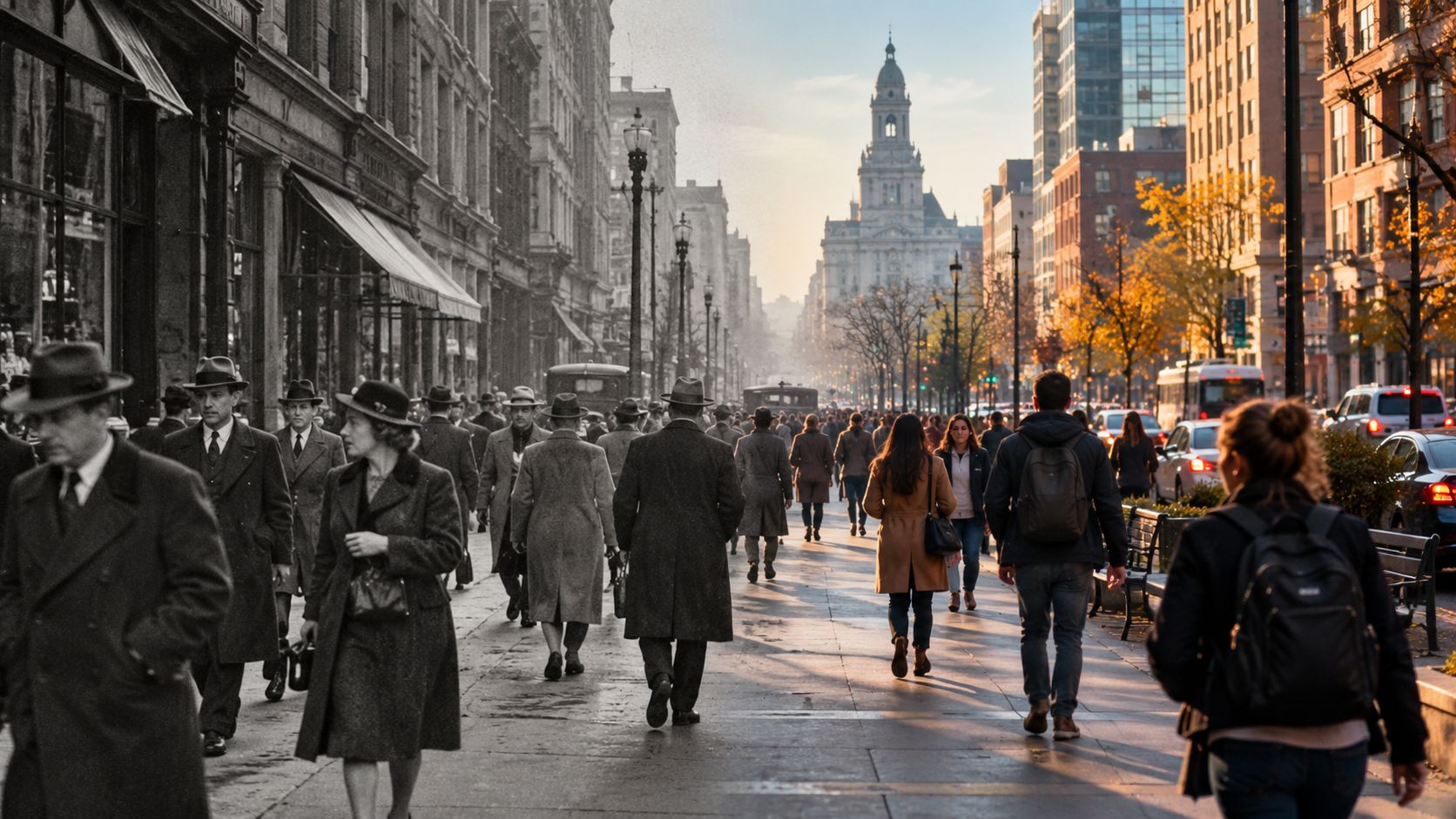
I made a social media post recently that said “Reconciling the 1940s in color has always been difficult—until now.”
Great as a one liner, but I felt the subject required more attention than that.
I was born in 1971. Color television was already part of the world I understood. World War II, Hitler, the concentration camps, the crowds, the trains, the bodies—all of that came to me largely in black-and-white. And somewhere along the way, the appearance of the footage became part of my understanding of the people in it.
They belonged to another world. They dressed differently. They spoke in other languages. Their movements looked strange on old film. Even once I understood intellectually that they were real people, there was a distance between their reality and mine. Sometimes they felt almost like characters.
I suspect that distance has done more damage to our understanding of history than we realize.
Those people woke up in color. Their children had favorite things. Their neighbors were irritating. Their shoes hurt. They worried about money, went to work, fell in love, and made plans for a future they expected to inhabit. The people imprisoned in those camps experienced their lives and their suffering in a way every bit as real as what we experience—because they lived—for real. Not as black and white characters in a black and white frame, but as whole people with whole lives.
And the people who put them there inhabited that same ordinary world. They inhabited it with the same self-justification people have always used, and always will — ourselves included — when acting in ways that further our own agendas, without deference to and in full ignorance or denial of cost.
That is what has become harder to keep at a comfortable distance. I’m watching detention abuses, the concentration of political power around one man’s personality, religious nationalism, and a country preparing for an election amid profound distrust. The familiar mechanisms have begun to speak English. They appear on my phone. In color.
America is in a dangerous period of democratic erosion, and the convergence of dehumanization, detention abuses, personal loyalty, religious claims to national ownership, and election distrust deserves an alarm proportionate to the danger. We still have choices. The point of recognizing the pattern is to make those choices while they matter.
History Happened on Ordinary Days
The United States Holocaust Memorial Museum documents how the Nazis combined political violence, propaganda, electoral participation, and political maneuvering to gain power. Hitler became chancellor on January 30, 1933; the destruction of democratic government followed through the exploitation of institutions and opportunities already available to him.[1]
The machinery that produced the horrors of the 1940s was being assembled in the years before them.
That’s where historical awareness ought to do some work. It ought to help us recognize what happens when a leader becomes the measure of truth, when an unpopular population becomes an explanation for national decline, and when institutions start accommodating conduct they once would have resisted.
The same museum explains that Nazi propaganda used current technology and sophisticated advertising to cultivate support, hatred, and indifference to persecution.[2] These were modern tools operating on modern people in their own present. We inherit their footage as evidence of an ancient moral failure, then congratulate ourselves on living later.
A newer camera is a very thin foundation for that confidence.
We also get to watch their story with the ending already attached, but they had to live through the middle. They had to decide what a particular arrest meant, whether a particular speech was dangerous, whether their discomfort justified speaking up, and how much inconvenience they were willing to accept on someone else’s behalf.
We are living through a middle now.
The People Behind the Fences
In July 2026, Human Rights Watch and the ACLU published an investigation of Camp East Montana at Fort Bliss. Researchers interviewed 71 people while detained there, along with family members and legal service providers, and reviewed government investigations and other records. They reported beatings, dangerous medical neglect, degrading conditions, coercive deportation practices, and barriers to legal representation. They also documented inaccurate detention-location records and accounts of families struggling to learn where their relatives had been taken.[3]
Those are concrete findings about identifiable people within a particular institution. They deserve investigation, access, and accountability.
Amnesty International’s December 2025 investigation of Florida’s state-run “Alligator Alcatraz” and ICE’s Krome facility described filthy conditions, medical neglect, prolonged restraints, and violent treatment. Amnesty concluded that some punishment amounted to torture. It also described failures to register and track detainees at the state-run facility, identifying circumstances that constituted enforced disappearance when whereabouts were denied to families and access to lawyers was blocked.[4]
Florida officials rejected Amnesty’s findings as politically motivated fabrications.[5] That makes independent access and examination of the evidence all the more necessary. A government responsible for people in custody has an obligation to account for their treatment.
Think about the actual experience involved. Someone you love is taken into custody. You try to find them. A system that ought to tell you where they are cannot give you a reliable answer. Meanwhile, they depend on the people holding them for water, food, medicine, and the ability to contact anyone outside.
That is an enormous amount of power to exercise over another human being.
Calling the person an immigrant doesn’t reduce the responsibility. They are still real people with real lives, real families, and real places in their communities. Questions about immigration status can be decided through a process that preserves a person’s dignity, access to counsel, and physical safety. Once cruelty becomes a means of making people leave, the state has begun using suffering as an administrative tool.
The historical parallel I see is in that permission: the growing willingness to make an unpopular category of people available for treatment we would immediately recognize as intolerable if it happened to our own families.
A Country Organized Around a Personality
A leader’s personality becomes a national danger when other people’s responsibilities begin revolving around protecting it.
A party can absorb it. Officials can learn to anticipate it. Wealth and access can collect around it. The leader’s preferences become tests of loyalty, and every correction starts to look like an attack. Eventually, ordinary mechanisms of accountability require extraordinary courage to use.
Trump’s effort to overturn the 2020 election is a documented example of that pressure. The House January 6 committee’s final report set out a multistep effort involving false election claims, pressure on state officials and the Justice Department, alternate elector arrangements, and pressure on Vice President Pence to interfere with the electoral count.[6]
A democracy depends on people being able to tell a powerful man that he lost, and have the answer mean something.
The damage also reaches people’s ordinary lives. Reuters reported on October 7, 2026, that many Federal Reserve officials identified tariffs and energy-price increases from the Middle East war, alongside technology investment pressures, as drivers of elevated inflation.[7] Choices exercised through political power arrive in household budgets. Confidence, spectacle, and declarations of success don’t pay the difference at the checkout counter.
For me, the danger of cronyism lies in the incentive it creates: people whose position depends on pleasing a leader acquire a personal reason to preserve his power. A country can accumulate an entire class of people for whom correcting the direction of government threatens their own future.
That’s a structural problem with very human motives.
When Belonging becomes a Religious Test
Christian nationalism claims political ownership through religion. PRRI measures it through attitudes about declaring America a Christian nation, grounding law in Christian values, making Christianity part of authentic American identity, and Christian dominion over society.[8]
Follow that premise to its practical consequence. If the country belongs especially to people of one faith, everyone else’s belonging becomes conditional. A political opponent can become an enemy of a sacred project. Losing an election can begin to feel like surrendering something God assigned you to possess.
That is combustible.
PRRI’s September 2026 report, drawing on December 2025 survey responses, found agreement that patriotic violence might be necessary to save the country among 28 percent of Christian nationalism Adherents and 25 percent of Sympathizers, compared with 17 percent among both Skeptics and Rejecters.[8] These are attitudes measured in a survey. They show a constituency willing to entertain political violence as a morally acceptable response to national danger.
Once people think their authority has divine authorization, a vote count can become an intolerable obstacle.
The Election in Front of Us
The November 3 midterms are approaching. The immediate question is whether institutions, leaders, and voters will allow votes to be cast, counted, and given their lawful consequence.
There is already evidence of conflict over the machinery. On October 9, a federal judge ruled unlawful the Justice Department’s effort to obtain state voter rolls and use an immigration database to demand removals of allegedly ineligible voters. Reuters reported that the judge identified the risk of wrongly disenfranchising eligible citizens, including naturalized citizens whose records could be outdated. The Justice Department said it was reviewing the ruling.[9]
An election’s legitimacy depends on what actually happens to voters and ballots. Accurate records, public scrutiny, independent administration, and reviewable decisions matter enormously in a climate where people are primed to interpret a defeat as proof of wrongdoing.
I am concerned about rejection of results across the political divide. The evidence of an organized effort to overturn a presidential defeat is especially concrete in Trump’s record. The wider vulnerability includes people who oppose him and are increasingly willing to imagine violence as a way to save the country.
PRRI’s survey released in January 2026 found that 19 percent of Republicans and 17 percent of Democrats agreed that patriotic violence might be necessary. Overall, 77 percent disagreed.[10] There remains a substantial public commitment to rejecting that premise, alongside a disturbing minority willing to accept it.
A country doesn’t require everyone to approve of violence before violence becomes a national problem.
Here is the danger as I see it: election manipulation or credible evidence of interference can generate outrage; unsupported accusations can generate outrage too. Threats, intimidation, retaliatory violence, and a coercive government response can then feed one another. Each escalation supplies another group with a reason to feel endangered and another excuse to escalate.
That is a plausible route toward serious civil unrest and, if institutions fracture and armed groups gain traction, a broader civil breakdown. Civil war belongs within the range of dangers worth discussing. The immediate evidence gives us reasons to confront the steps that could carry us there, while those steps can still be interrupted.
The Choice Still Available—for Now
My position has practical consequences. Detention facilities need independent inspection, reliable records, access to lawyers and families, adequate medical care, and accountability for abuse. Election workers need protection. Election administration needs public scrutiny and freedom from partisan coercion. Documented irregularities need investigation and correction. Officials need to honor lawful outcomes even when doing so costs them power.
And people who believe they are defending democracy need to preserve the humanity of the people they oppose. Peaceful protest, reporting, litigation, organizing, and voting can impose real costs on abusive power. Those avenues need protection precisely because they allow a society to correct itself before conflict becomes bloodshed.
The coming weeks matter. So does what follows them. Every successful defense of an institution preserves another place where accountability can happen. Every abuse excused because it serves our immediate interests teaches someone that the next abuse may be excused too.
Americans possess the same human capacities that have carried other societies into catastrophe: fear, loyalty, resentment, ambition, indifference, and the ability to make almost anything sound reasonable when our own advantage depends on it. We also possess the capacity to recognize that process and interfere with it.
Our language won’t protect us. Our clothes won’t protect us. Our place on a map won’t protect us.
What we do might.
Eighty or a hundred years from now, people may be watching footage from these years and asking how a society with so much information could have allowed itself to come apart. They may study our speeches, our detention facilities, our crowds, and our excuses as object lessons for societies trying to rebuild.
I would like us to give them something better to study: the moment enough people understood the danger and acted while they still could.
This isn’t meant to make anyone comfortable. None of us should be comfortable right now. This is a call to the highest level of alert. When you’re sounding an alarm, you don’t check the volume first.
You tell people where the fire is. It’s here. Right now! Fire!
Sources
[1] United States Holocaust Memorial Museum. “Adolf Hitler and the Nazi Rise to Power, 1918–1933.”
[2] United States Holocaust Memorial Museum. “Nazi Propaganda.”
[3] Human Rights Watch and ACLU. “You’re Only Getting Out Deported or Dead”: Abusive US Immigration Detention at Ft. Bliss. July 15, 2026.
[4] Amnesty International. “USA: New Findings Reveal Human Rights Violations at Florida’s ‘Alligator Alcatraz’ and Krome Detention Centers.” December 4, 2025.
[5] Axios. “Human rights org reports ‘torture,’ ‘inhumane’ conditions at Alligator Alcatraz.” December 5, 2025. Reports the Florida administration’s response.
[6] U.S. House of Representatives, Select Committee to Investigate the January 6th Attack on the United States Capitol. Final Report. December 2022. Executive summary and Chapters 1–5.
[7] Reuters. “NY Fed September survey finds public expecting more near-term inflation.” October 7, 2026.
[8] PRRI and Meanings of Democracy Lab. “Resistance to Christian Nationalism in All 50 States.” September 24, 2026. Measurement section and findings on political violence; violence comparisons refer to December 2025 responses.
[9] Luc Cohen, Reuters. “US judge rules Justice Department use of voter rolls unlawful.” October 9, 2026.
[10] PRRI. “Survey: Americans Point to Political Leaders’ Failing to Condemn Their Followers’ Violent Rhetoric as Top Contributor to Political Violence.” January 16, 2026.