
The Counsel (Daughter of Fire, Episode 4)
The Twenty-Ninth Year of the Reign of Maren Tanwen, Queen of Caelmark
Aldric was dying. He was doing it the way he had done everything — slowly, correctly, without complaint, and in a coat that was wrong for the occasion.
He was eighty-seven. He had been failing for a year in the way the very old failed, by subtraction — a little less range in the mornings, a little less appetite, the stairs taken one at a time and then not taken at all. His rooms were moved down to the ground floor without anyone deciding to move them, the household simply arranging itself around the shrinking of him the way a river arranged itself around a stone going slowly to sand.
He still came to her early. He still set the cup beside her without asking. His hand shook now when he set it down, though. Neither of them remarked on the shaking, because remarking on it was not how they did things and the not-remarking was the last of the old language they had left.
Maren read him every morning and did not say what she read aloud.
What she read was a man with months; then a man with weeks. She had read a great many deaths in twenty years of the ash fields and she knew the testimony of a body letting go of its tenancy. Aldric’s body was giving notice politely, the way he gave everything, and there was nothing in her power that could be done about it. She had eons of stewardship in her. She could read any soul in the kingdom to its foundation. She could not add a season to the life of the one man who had spent fifty years finding her and never once arriving with the thing that would have made the finding unnecessary.
She brought him the work anyway, because he wanted it. The man who had governed for fifty years did not want to be handled at the end of it. He wanted to be useful. Allowing him to be useful was the only mercy she had left to give him.
It was the work that brought the question.
“The succession,” Aldric started.
It was morning. The cup was beside her, the shake of his hand still cooling in the air between them. He had waited, she understood, for a morning he had the range for it. He’d spent some of his thinning store of mornings holding the question back until he could put it correctly.
“You have years in you yet,” Maren said.
“I have weeks in me and you know it better than I do. We are not going to spend one of them pretending otherwise.” He said it plainly, without self-pity, because he’d already made his peace with it. “The Prime Ministership is going to be vacant. Soon. It cannot be vacant for long. A throne that does not die needs a first minister who does, or the kingdom will forget that anyone but you decides anything. A kingdom that forgets that is a kingdom with one point of failure.” He looked at her. “We built better than that. Don’t let it rot at the end because you didn’t want to choose while I was still here to make the choosing easier.”
“Then make it easier.”
“That’s why I raised it.” A pause that had weight in it. “There’s an obvious answer. You know the answer. The whole court knows the answer. She’s the most able person in this kingdom. She has been the most able person in this kingdom since she was thirteen years old and took the teeth out of a coast delegation without raising her voice.”
Maren said nothing.
“Give it to anyone else and the court will know you reached past her to do it,” Aldric said. “They’ll know what it means. So will she.”
“And if I give it to her?”
Aldric was quiet for a moment. He turned the cup on the table, the small ritual of a man arranging his thoughts in their order before he let them out. Maren waited, because whatever he had been holding back across the rationed mornings was about to come. She had learned a long time ago not to hurry a man toward the thing he had been bracing to say.
“If you give it to her,” Aldric said, “you will be handing the one person who has the most reason to want your reign to end the instrument that ends it.”
He let that sit.
Maren did not move. Outside the ground-floor window the kingdom was waking, the capital’s morning noise coming up through the glass, the city that was hers stretching, complaining, beginning its day around the center it could not see was about to crack.
“Say the rest of it,” she said.
“You know the rest of it.”
“Say it. You’ve spent a morning on it. Finish.”
Aldric set the cup down. His hand shook. Neither of them remarked on it.
“She loves you,” he said. “I want to say that first, because it’s true, and because what I’m going to say next is also true and the two of them living in the same person is the whole of the problem. She loves you and she is the best of us. She has understood since she was a girl that she will never sit the throne while you live and that you are not going to die.” He looked at her steadily, the restraint that had been his whole life doing its last work. “I have watched her understand it in pieces for twenty years. I held her on her first day. I have watched her grow into exactly the queen this kingdom would beg for. I have watched her come to know that the kingdom will never have her as long as it has you. She has carried that knowledge with more grace than I could have, but that grace does not change what the knowledge does to a person across twenty years.”
“You think she’d move against me.”
“I think she already has, in every way that doesn’t yet have a name.” He said it gently, the way he had said hard things to her for fifty years, as a man delivering evidence rather than a verdict. “The garrison vote. You remember it. She stood up in council five years ago and told the kingdom, in the kindest voice anyone there had ever heard, that a kingdom safe because of one person is not safe. It was true. It funded a sound border. And it was the first time anyone said out loud that the kingdom needs to outlast you. The person who said it first was your daughter, and the room loved her for it.” A pause. “She wasn’t wrong, Maren. That’s what you have to understand. None of it requires her to be wrong. She is right, she is able, she is loved, and she is foreclosed. The only thing standing between her and everything she was built for is a mother who will not age. Give her the Prime Ministership and you give her the government. Give her the government and she will not need to do a single dishonest thing. She will simply be better at governing than the absence she’s governing around. The kingdom will arrive, lovingly, by degrees, at the conclusion that it would rather have the daughter it can keep than the mother it cannot move.”
Maren looked at her hands on the table. They were steady. They were always steady.
“And if I pass her over?” she asked.
“Then it’s worse for you and better for the kingdom — for a while.” Aldric’s voice had gone quiet, down to the register he used for the deaths. “She’ll know what it means. It will hurt her in a way I would give a great deal to spare her and cannot. She’ll grieve it. The grief will go somewhere, and where it goes will be to you, because there’s no one else for it to go to.” He stopped. “But she won’t have the machinery. She’ll have the truth, the talent, and the love of the court. Those are formidable, but they are not the same as the machinery. Passing her over does not save you. Nothing saves you — you’ve a thousand years and she has the right to it. The long arc of this only ends one way. Passing her over buys the kingdom time to be more than a thing that depends on you. That’s all it buys. Time. Bought at the cost of your daughter’s understanding that her mother chose the kingdom over her.”
The capital’s noise came up through the window.
“You’re telling me to break it myself,” Maren said. “Now. Cleanly. Rather than let her break it later.”
“I’m telling you that passing her over is the lesser catastrophe,” Aldric said. “I have spent fifty years giving you the accurate thing instead of the kind thing, because you asked me to, on the first day, without words. I have never once failed to give it to you. This is the last of it. The accurate thing is that you have two catastrophes in front of you and no third option. The smaller one is the one where you choose, and bear what choosing costs. The kingdom survives long enough to learn it can stand on something other than you.” He looked at her. “I held her on her first day. I am telling you to wall her out of the government. I want you to know what it costs me to tell you, so that you’ll believe me when I say I’d not tell you if there were any other true things to say.”
Maren sat with it.
She could read any soul in the kingdom to its foundation but one. She did not need to read Aldric, because Aldric had never once made her read him. He had given her, for fifty years, the truth without making her dig for it, which was its own kind of love and the only kind he had ever offered her. He was offering it now. The last of it. The accurate thing, spent on a morning he could not spare, against the girl he had held on her first day.
“You’re certain,” she said.
“No,” Aldric said. “I’m dying. Certainty is a luxury for men with time to be wrong. I’m giving you the best reading I have left, and it’s still the best reading in this kingdom. The only one better belongs to the person we’re discussing and you can’t ask her.” A pause that almost held something lighter, the ghost of the old comedy. “I’d have liked to be certain for you. At the end. I’d have liked to hand you one clean thing.” He set his shaking hand flat on the table to still it. “This is what I have. Take it or don’t. But decide while I can still watch you do it. I’d like to be useful once more before I’m not anything.”
Maren looked at the oldest trust of her life, dying in a coat wrong for the weather, spending his next-to-last strength to arm her against her own child.
“I’ll decide,” she said.
“Decide now.”
“I’ve decided,” she said, because she had, in the way she decided the things that could not be evidenced all the way down — by weighing what she could see, trusting the man who had never given her a false reading, and letting it run. “She’s passed over. You’ll help me choose someone who isn’t her.”
Something went out of Aldric. Not relief. It was the thing that goes out of a man when the last task he sets himself is accepted and he can stop holding himself to the height of it.
“Tomorrow,” he said. “I’ll be better in the morning. We’ll choose in the morning.”
He was not better in the morning; but they chose, across three more of his rationed mornings, the steady unremarkable regent who would hold the office and never reach for more. On the last of those mornings, Aldric approved the choice with a nod and a single word. The work of his life was done.
The decision was made real the way decisions were made real, in rooms, on paper — but there was one room Maren made herself be in. She did not believe in handing other people the parts of a choice that were hardest to look at and keeping only the clean parts for herself.
The regent’s name was Holt. He was sixty, sound, and unremarkable in a way that was its own qualification — a man who had administered the southern revenue districts for thirty years without once being suspected of wanting anything more than to administer them well. When Maren told him that he would be the kingdom’s next Prime Minister, she watched him understand it in stages. The stages were the foreclosure in miniature, and she made herself read every one.
First there was disbelief, because a man like Holt did not expect the great offices — he had built a life on not expecting them. Then the pleasure, brief and human but quickly hidden because it was a great thing to be offered and he was not a saint. And then — this was the one she made herself really read — the other thing arriving underneath the pleasure, the cold practical understanding of a sound man who could count.
He knew whose office this was. The whole kingdom knew whose office this was. And here was the queen handing it to Holt of the southern revenue, which meant the queen had reached past the princess to do it. That meant Holt was about to spend the rest of his career as the visible answer to a question no one would ask out loud: why not her? He would stand in council beside the woman the office belonged to. He would carry the title she was built for. Every soul in every room would know he was holding her chair, and so would she. So would he.
“Your Grace,” Holt said, when he had finished arriving at all of it. He did not refuse it. Men like Holt did not refuse their queen. The office was real, and he would hold it well, but something had gone out of the pleasure. What was left was the face of a decent man who had just understood he was being made into a wall, would be a wall for the rest of his life, could not say no to it without insulting the throne, and could not say yes to it without knowing exactly what he was for.
“I know what I’m asking,” Maren said. It was as close as she would come to telling him she had read the whole of it off his face and would not pretend she hadn’t.
“Yes, Your Grace,” Holt said. “I expect you do.”
That was the foreclosure. Not the paper. The paper was nothing. The foreclosure was a sound man’s face arriving, in stages, at the knowledge of what he had been chosen to be. Maren stood across from him having chosen it, on a dying man’s counsel, with her steady hands at her sides.
Elandara learned it the way she learned everything — early, before it was announced. She tracked the movements of the court the way her mother tracked a kill site. The rearrangement had its own signature and she could read it.
Maren was there when her daughter understood.
There was not a scene. Maren had half-expected one and got none, because her daughter did not make scenes and never had in twenty-six years. Maren stood in the council antechamber and watched the understanding arrive in the girl across the room. She watched her read the appointment in the set of Holt’s shoulders, in the way two older councillors stopped talking when she entered, in the whole quiet machinery of a court that had been told who the next first minister would be — and was told it was not the princess.
Elandara’s face did the thing it always did. It opened, the whole face turning, and Maren read in it — nothing. The foundation was closed, as it had been closed for twenty-six years.
But she could read the want, because want was behavior. The want in her daughter that morning was no longer a child’s want. There was no reaching in it. It was still, it was certain, and it had finished becoming whatever it had been since a council chamber five years ago. It pointed — Maren could see the direction of it without being able to read its content — at her.
Maren understood, watching it point, that she was seeing the gift turn.
She had watched it grow for twenty-six years — the warm reading, the handle found and turned, the thing the child had built in a schoolroom out of the need to be loved instead of feared. Maren had watched it work on envoys and councils and the whole kingdom, always outward, always warm, always given as a gift. She had never once seen it aimed. For twenty-six years the gift had run downhill toward people, gathering them in. And now, in a council antechamber, on the morning the girl learned she was walled out, Maren watched the same gift go still and cold and turn, for the first time in its life, toward a single target.
Her daughter’s gift did not lose its warmth. That was the thing Maren read and could not get past. It would never lose its warmth. The kingdom would feel only the warmth and would never feel the aim underneath it. Only Maren, who had watched the gift its whole life, could see that the warmth had acquired, that morning, a direction. Not toward Holt, who had only been handed the office. Not toward the council, which had only accepted it. Toward the throne — toward the mother on the throne, who had reached past the most able person in the kingdom to give the government to a lesser one. She could only have done such a thing, the girl’s whole still body said, for one reason. She chose the kingdom over me. The girl had the right target and half the reason. The missing half was the half that would have changed everything, and it was the one half Maren could never hand her.
Because Elandara did not know about the counsel.
She would never know about the counsel. Aldric had given it to her in a ground-floor room across four rationed mornings and he would carry it into the ground within the month. The girl who loved him would bury him believing he had been, to the end, the one man wholly on her side. She would lay every part of the foreclosure at the foot of the throne — where her mother sat alone with the truth and could not say a word about it. Telling her would waste a dead man’s last gift and still not give the girl the thing she’d been built for.
Maren watched her daughter aim twenty-six years of grace, understanding, and foreclosed brilliance at the throne. She couldn’t defend the throne, because the defense was a secret that belonged to a dying man and the grave he was going to.
She had made the decision. She would make it again. The choice was the lesser catastrophe. Aldric had been right and she had let it run.
It did not feel like the lesser catastrophe. It felt like the morning she had stopped leaning on a wall she’d leaned on for twenty years, except there was no relief on the other side of this one, only a daughter across a room who had just decided, finally and forever, that her mother was the thing standing between her and her life.
Elandara crossed the antechamber. She came to her mother and she kissed her cheek, warm and real, in front of the councillors, the way she always did. She said something light and correct about the new appointment. Maren read the kiss the way she had read every kiss since the first day — in the body, and no further.
Then the girl was gone, and the court rearranged itself to the last small degree. The thing was done.
Aldric died eleven days later, in the night, the way Hesper had, the way he had probably hoped to — without struggle, without a scene, the old man simply not waking. Maren was with him at the end, though. She had been sleeping in the chair in the ground-floor room for a week by then, against the protests of the household, her own first minister, and everyone whose business it was to protest. She had ignored all of them, because there were things a queen did not delegate. Sitting with the oldest trust of her life while it ended was one of them.
He woke once, near the middle of the last night.
The lamp was low. She was in the chair. He surfaced the way the dying surfaced at the end — briefly, with a clarity that was its own kind of warning. He found her in the low light and he did not perform anything. He never had.
“You’re still here,” he said.
“I’m still here.”
“You should sleep.”
“I sleep in the chair. My body’s needs aren’t contingent on the weight of what I’m carrying. You taught me that. No —” a thing that was almost the old comedy “— the ash fields taught me that. But you watched and let me learn it.”
Aldric’s mouth moved, the ghost of a smile. He was quiet for a while. The capital was silent outside, the deep middle-of-night silence of a city asleep, the one hour the noise let go.
“She’ll blame you,” he said. “For all of it. She won’t know about the counsel. She’ll lay it at the throne and she’ll be wrong about the half of it that was mine.” His voice was very quiet, down below the register of the deaths now, down in the place where a man said the last true things. “I’m sorry for that. I’ve thought about telling her, in these last days, so she’d have it right.” A pause. “I decided not to. She’d grieve me as the man who locked the door, and she’d be right to; but it wouldn’t open the door, and you’d lose the only thing the choice bought you, which is a daughter who at least had one of us wholly. Let her keep me clean. Let her keep one of us.” His hand moved on the blanket and found her steady one, the grip almost nothing now. “You’ll carry it instead. The truth of why. Alone. For a long time.” His eyes found hers. “I’m sorry it has to be you. But you’re the one built to carry things alone, and you’re the one with the time. You’re the one who can bear her thinking it of you, because you’ve borne worse and you’re still here.” The grip tried to tighten and could not. “Don’t tell her. Promise me. Let me take it with me.”
Maren looked at the man who had found her seven times in eleven years, who had never used what he knew as a weapon, and who had spent his last strength arming her against her child. His last moment of clarity was making sure the child would never know he’d done it, so that the girl could keep one person clean. The queen would carry the wall alone because the queen was the only one with shoulders that wouldn’t break under the pressure.
And she thought, because she could not help thinking it, of Elandara’s first morning. The child an hour old, screaming at the midwife and the cold and her own mother, being handed from arm to arm — and going quiet, the one time, for this man. The first choice her daughter ever made, before she had language to make it with: that the old man with the careful hands was the one to go still for.
Twenty-six years later the old man with the careful hands had made his last choice, which was to wall the child out of her life’s work and die before she could learn he’d done it. The first person Elandara ever chose had just chosen against her, in love, completely, and arranged it so she would lay flowers on his grave believing he had been hers to the end.
That was the shape of it. The child had read him right at one hour old — he was the one to trust. She had never once been wrong about him, except in the one way she would never know she was wrong, which was the way that would have changed everything.
“I promise,” she said.
“Good.” The word came out on almost no breath. His hand went slack in hers — not death yet, only the slackness of a man who had set down the last thing he was carrying. “Good. Then it’s done. The work’s done.”
“The work’s done,” she said.
“I’d have liked to see her on a throne somewhere,” Aldric said, to the low ceiling, to the dark, to the fifty years behind him. “She’d have been magnificent. She’ll be magnificent regardless. You both will. I got to watch the whole —” his eyes drifted, came back, drifted “— the whole shape of it. Bonepicker to throne. Not many men get to watch a whole shape. I got the whole shape.”
“You did.”
“It was a good shape,” he said.
Those were not quite his last words but they were the last ones that were for her. Maren sat in the chair through the rest of the night, held the slack hand, and did not sleep. Somewhere before the light his breathing changed and lengthened and then, between one length and the next, simply did not come again. The oldest trust of her life was over. The last person alive who had truly known her as the bonepicker was gone. She was alone in her own life in the way longevity had been promising her since the morning she named her daughter.
She stayed in the chair until the light came up the right color.
She stood, brushed the stone-cold stiffness from her hands, and went to do the thing that came next. The thing that came next always came and a queen who was up before the light could begin it before the kingdom woke and started having opinions about its grief.
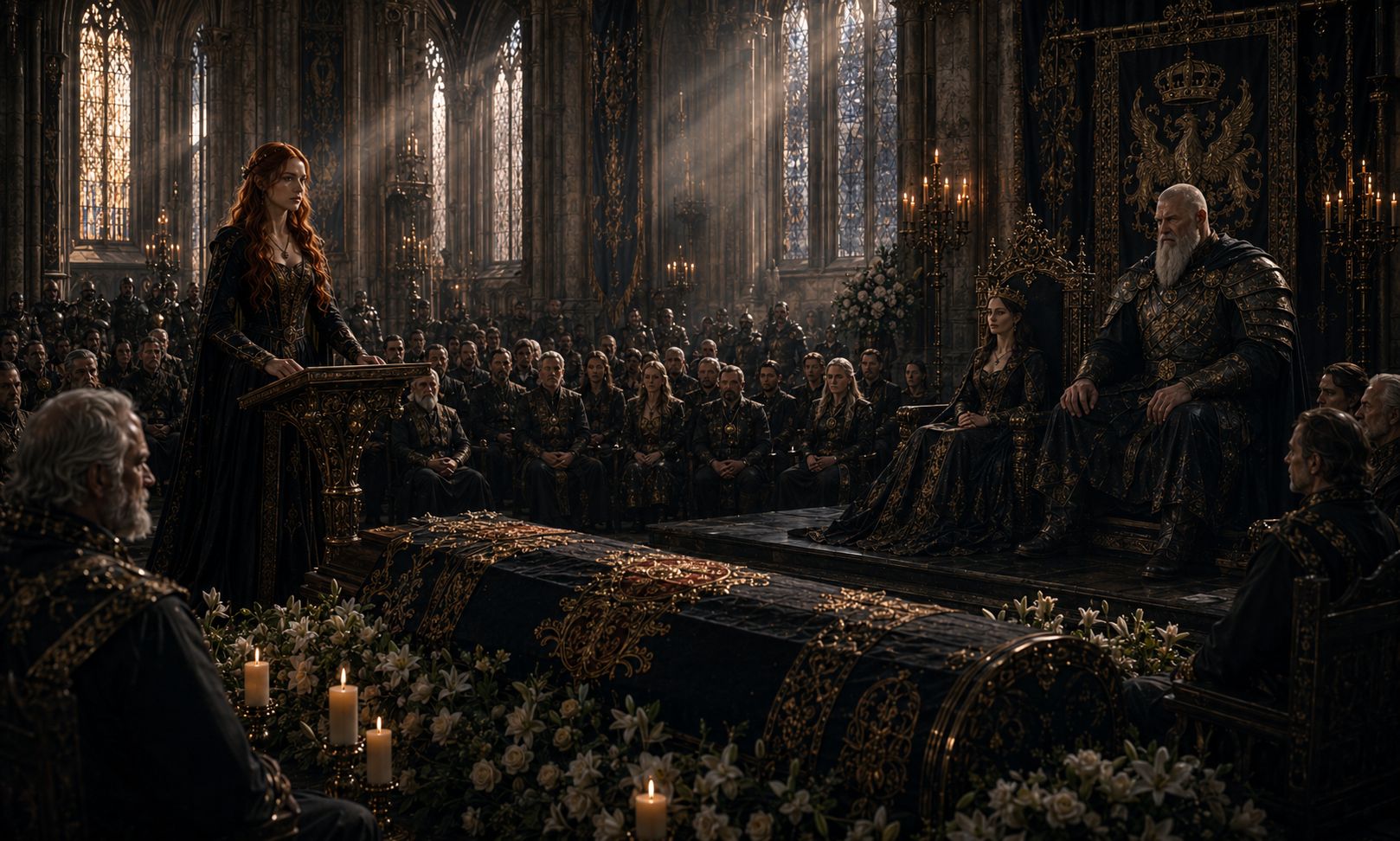
They buried him in the great hall.
It had been built to hold a crowning and it held the coffin well, because the architects who had built for one ceremony had not known they were also building for the other. The two were closer in shape than anyone liked to say aloud.
Maren chose his coat. It was the last thing she could do for him and she did it the way she did everything — correctly, without examining what the correctness held at bay. She had it cut from cloth that was, for once, right for the room he’d lie in — warm enough, fine enough, a coat that would have been wrong for the ash fields and was exactly right for this. It was the first coat she had ever known him to wear that suited where he was.
The hall filled. The kingdom’s importance came in their good coats. The dressed stone he had ordered cut years ago and never lived to see finished stood finished now at the front. Maren looked at it and understood that he had ordered his own resting place and not told her, the way he had done a hundred quiet correct things and not told her. She was only learning the shape of his preparations now that he was inside them.
Arik was at her left shoulder, gone grey, the size of him undiminished but the weight of him changed.
Her daughter walked to the front of the hall to speak and the room adjusted around her the way a current bends around a stone. Maren sat in the front row and did not move, watching Elandara stand at the head of the hall beside the man who had held her on her first day, loved her wholly, locked the door against her, and let her never know it. She began, in a voice the whole kingdom would believe, to grieve him.
Maren knew what was coming. She had heard the front of it in the antechamber, in the still certain want that had no reaching left in it. She knew the eulogy would be true and that its truth would be the most dangerous thing in the room — that her daughter would mean every loving word, and that every loving word would also be the opening move of a war whose true cause sat in the front row, alone, sworn to silence over a grave.
She had carried weights before.
She settled this one across her back and hips the way she had settled a pack ten thousand times, correctly, without thinking about it. She folded her steady hands in her lap and listened to her daughter begin.
“He found me first,” Elandara said.
The years closed the last of their distance, and there was nothing left between what had been and what was. Only the hall, the coffin, the queen and her daughter, and the dead man between them.