
The Eight Seats Around the Fire
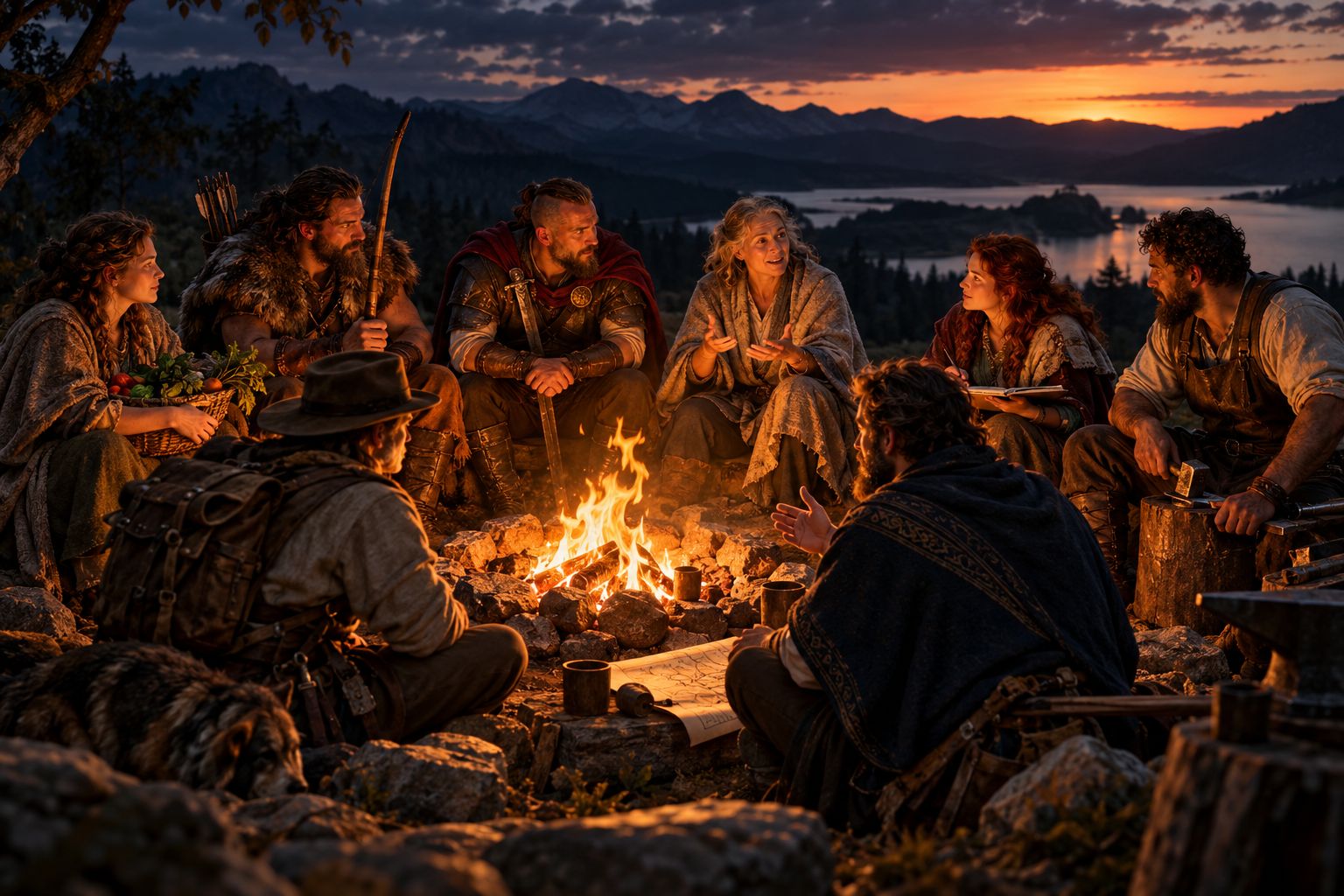
A few weeks ago, I told you that every human being is built to fill one of eight seats around the village fire. I also promised to walk you through them one by one. We’re going to start doing that today.
First, a bit of housekeeping. In the previous post I called one of the seats the “Floater.” I’ve since renamed it the “Wright.” “Floater” made this person sound like someone drifting with no seat of their own, when the truth is the opposite: this is the person who can sit in any seat. Wright is the old word for a worker who makes things, and it survives in words like wheelwright, shipwright, millwright, and playwright. For our purposes, both the Wright and the Smith make things. The Smith builds things to work and keep working and is fulfilled by the making itself, while the Wright runs on the good ’nuff principle and is fulfilled by solving whatever problem is in front of them, in a pinch. A Smith may build a better fix someday, but the Wright makes it work today. This is the guy who figured out you could use a bullet to close a circuit if you didn’t have a fuse (don’t do this; it’s dangerous). The Smith is the guy who discovers it later, says “what idiot did this?” and replaces it with a proper fuse.
They are both useful: The Wright made it work in a pinch. The Smith makes it work correctly, predictably, and optimally. Broken down in the middle of the desert on a hot day, you want the Wright because the Smith doesn’t have the right parts.
The Wright is what some would call a jack-of-all-trades, but that phrase comes with baggage. For our purposes, the word is (appropriately enough) “Wright”. It was the right name all along—kind of.
The Drifter is real, by the way. It just isn’t someone with a seat. It’s what happens to any engine that’s been starved long enough, and we’ll get to that.
Now, the eight seats:
The Farmer
Fed by things that grow.
The Farmer is the village’s future. While everyone else is living today, the Farmer is planning for next spring, storing for February, and noticing the field is tired before anyone else sees it. A village without Farmers eats well all summer and dies in the winter.
Farmers come in two types. The Cultivator tends one thing across seasons, whether that’s a field, a herd, a savings account, a garden, or a craft practiced for thirty years, and is fed by watching it deepen. The Gatherer knows what’s ripe and where, and brings it home: the one who remembers which bushes fruit in which week; who today is the collector, the bargain-finder, and the person with a full pantry and a spare of everything. The Cultivator gives the village depth. The Gatherer gives it reserves.
The Hunter
Fed by the pursuit.
The Hunter brings in what the village can’t grow. Meat, yes, but also news, trade, and opportunity: anything that has to be gone after rather than waited for. Hunters come alive in the chase and go quiet when there’s nothing to chase.
There are three kinds of Hunter. The Chase-Hunter runs it down, and today you’ll find them closing the sale, beating the deadline, or winning the race. The Trapper is patient: they set the snare, build the system, and let the prey come to them, like the investor, the researcher, or the person whose plan works while they sleep. The Scout goes out ahead to find where the herds went and where the new ground is, and comes back to tell everyone. The Chase-Hunter feeds the village today, the Trapper feeds it steadily, and the Scout tells it where to go next.
The Warrior
Fed by real stakes.
The Warrior stands between the village and whatever would destroy it. That means raiders and predators, and it also means injustice, bullies, and the slow rot nobody else will name. Warriors are at their best when something real is on the line, and at their worst when nothing is.
There are two kinds of Warrior. The Offensive Warrior goes out to meet the threat before it reaches the gate. This is the litigator, the activist, the one who says we are doing something about this, today. The Defensive Warrior holds the line and protects what already stands: the guard, the wall, the person nothing gets past. One carries the fight to the enemy. The other makes sure there’s still a village to come home to.
The Cleric
Fed by people healing.
The Cleric tends the body, the spirit, and the bonds between people. Every caregiver, healer, and teacher sits in this seat. When the village is sick, grieving, lost, or coming apart, the Cleric is the one who holds it together.
There are two kinds of Cleric. The Prophet speaks to the whole village at once. The Prophet names what’s wrong, calls people back to what matters, and teaches the room. The Shepherd tends the few up close, like the nurse at the bedside, the counselor, or the friend everyone calls at two in the morning. The Prophet heals the village. The Shepherd heals the villager.
The Artist
Fed by the moment you finally see it.
The Artist holds the village’s memory and meaning. They tell the stories, carve the images, and sing the songs that remind people who they are and why any of this matters. A village without Artists survives, but it forgets why it bothered.
There are two kinds. The Reflector shows the village itself as it truly is: the storyteller, the documentarian, the satirist, the portrait painter who won’t flatter you. The Visionary shows the village what could be: the one who draws the thing that doesn’t exist yet so everyone else can see it. The Reflector keeps the village honest. The Visionary gives it somewhere to aim.
The Smith
Fed by things that work.
The Smith makes the tools, the shelter, and the things that hold. Every blade, roof, hinge, and bridge came from someone in this seat. The Smith is happiest with their hands on a problem that can be solved, and most satisfied when the thing they built just keeps working, year after year, without anyone thinking about it. We tend to say civilization was built by Farmers. It was built by Farmers and Smiths alike.
There are two kinds of Smith. The Craftsman, or Fixer, makes things well and keeps them running. This is the one who builds it right the first time, and who’s already under the hood when it breaks. Today that’s the mechanic, the carpenter, the maintenance man, and the person who can’t walk past a wobbly table without fixing it. The Inventor, or Toolsmith, makes the thing that makes the things: a better plow, a stronger axle, the tool nobody knew they needed until it existed. The Craftsman keeps the village standing. The Inventor changes what the village is able to do.
The Chief
Fed by the whole group winning.
The Chief makes many hands into one thing. When the village has to decide, organize, move, or survive something together, the Chief is the one who turns a crowd of individuals into a people.
There are two kinds of Chief. The Manager runs the system: who does what, when, and with which resources. This is the one who keeps the operation from falling apart. The Visionary Chief points the village somewhere, deciding where we go, what we’re becoming, and why it’s worth the trouble. The Manager makes sure the village works. The Visionary Chief makes sure it’s going somewhere.
The Wright
Fed by wearing every hat in the building.
The Wright covers the gap. When the Hunter breaks a leg, the Smith falls sick, or the Chief is away, the Wright steps into the empty seat and the village keeps running. Wrights are fed by variety itself: by being needed in a new way today, and by knowing a little of everything and a lot of enough.
There are two kinds of Wright. The Village Wright stays put and knows every job in town, the utility player who fills whatever seat is empty this week. The Journeyman Wright travels from village to village, carrying skills and knowledge wherever they’re needed. Today that’s the contractor, the consultant, or the person on their sixth career who was good at all of them. The Village Wright makes one village resilient. The Journeyman Wright connects villages to each other.
✷✷✷✷✷
That’s the makeup of the village sitting around fire. Eight seats and seventeen ways of sitting in them.
Remember what I said last time: you do all eight, every day. Everyone does. You tend, you chase, you build, you defend, you make meaning, you organize, and you cover gaps. But one of those, your seat, fuels you while the rest cost you.
In future weeks, I’m going to take them one at a time. Each seat will get its own explanation, covering what it did around the first fires, where it lives today, what it looks like when it’s fed, what it looks like when it’s starving, and how to feed it when your life won’t. Stay tuned for more!