
What She Was For (Daughter of Fire, Episode 3)
The Sixteenth Year of the Reign of Maren Tanwen, Queen of Caelmark
1. THE DELEGATION
She was up before the light, and so was her daughter.
That was new. For thirteen years the child had slept the same way she did everything, all the way down, nothing held back. Maren had gone to look at her each morning in the dark and come away again. On that particular morning the cot was empty and made, the blanket squared at the corners the way Arik squared a bedroll. Maren stood in the doorway of the empty room and read it the way she read a site where something had moved on before she arrived.
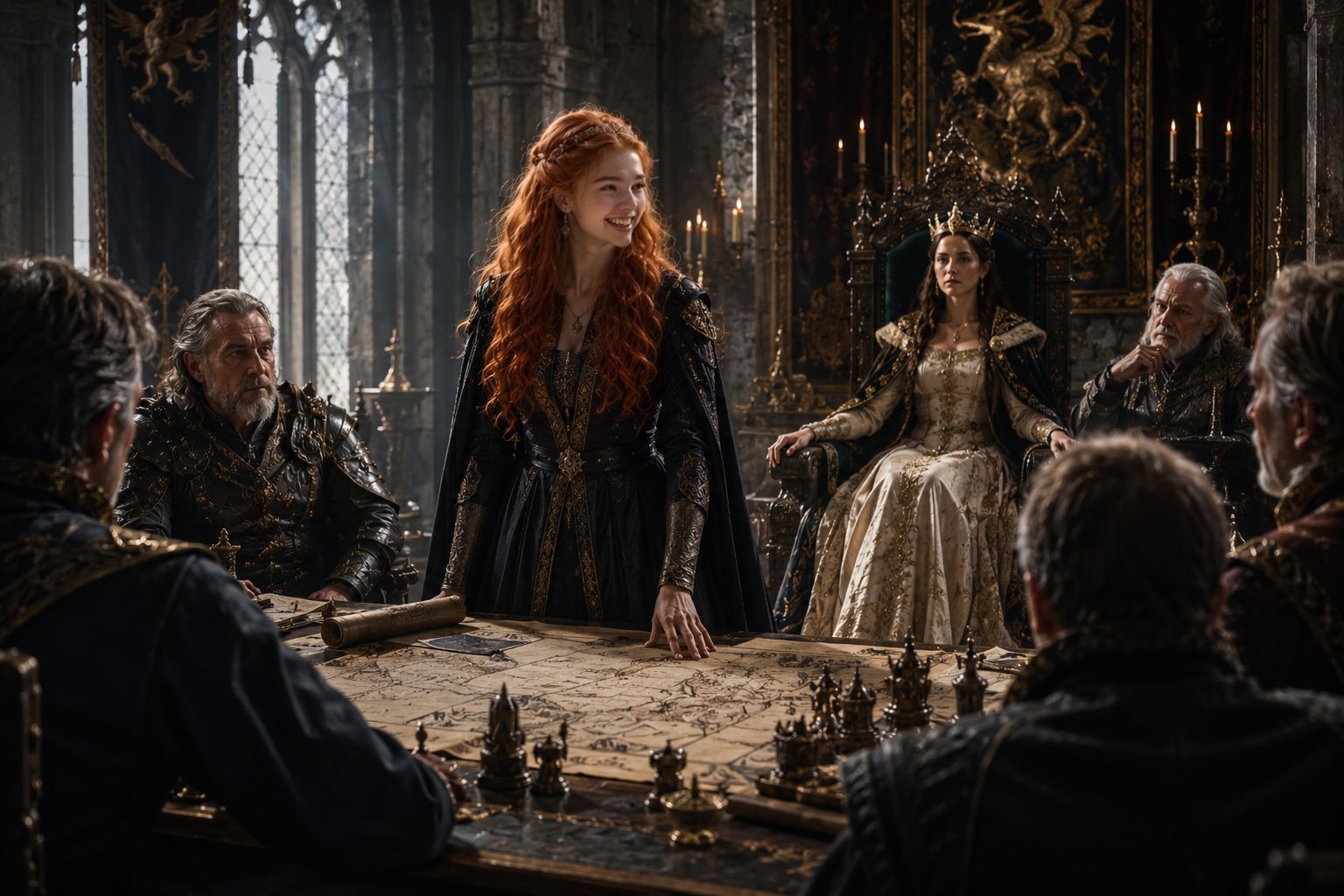
She found the girl in the east room with the good windows, already dressed, sitting at the table with the delegation’s papers spread in front of her.
She had not been given the papers. They had come up the night before from Aldric’s office for Maren’s morning reading. The girl had gotten to them first, which meant the girl had known they would be there, which also meant the girl had been tracking the delegation’s progress toward the capital the way Maren tracked it. She had said nothing and then had risen in the dark to read the papers before her mother could.
“They come from the coastal confederacy,” Elandara said, without looking up. Thirteen years old, copper hair pulled back hard the way she wore it when she meant business, her father’s blue eyes going down the lines of trade figures. “Six of them. The one who’ll do the talking is the second name on the list, not the first. The first name is old, important, and tired. He’s brought the second one to be the teeth.”
Maren moved to stand behind her and looked at the papers over the copper head.
The girl was right about the second name. Maren had read the same thing the night before. It had taken her the trade history, the routing of the party, and the order of the seals to arrive at the conclusion. She did not ask how the girl ended up there. She had learned not to ask the girl how she got places, because the answer was always the same answer — she did not know either. She arrived at the conclusion the way water arrives at the bottom of a slope, because running downhill toward people was what she did.
“You’re not in the audience today,” Maren said.
The girl looked up. Her whole face turned, the way it always turned, and Maren read in it — nothing. The thing she could never read. But she could read the want under it. Wanting was behavior and even her daughter’s wants showed in the body. The want was plain: let me in the room.
“I’ll stand in the back,” Elandara said. “I won’t speak. I want to watch you do it.”
It was true. Maren could hear that it was true. It was also not the whole of it, and the part that was not the whole of it was the part she could not read. Maren made the decision the way she made the ones she could not fully evidence. She weighed what she could see, decided the variables would hold, and let it run.
“The back,” she said. “You don’t speak.”
“I don’t speak,” the girl agreed and went back to the papers. Maren stood a moment longer behind the copper head and felt the unease she had carried since the kitchen passage six years ago turn over in her once, slow, like a thing in deep water changing depth.
*****
The confederacy envoys came in cold.
They came in the way of people who had decided, somewhere on the road, that the kingdom of an ageless queen was a thing to be handled rather than honored — that whatever Caelmark was, it was strange, and strangeness was leverage if you did not let it impress you. The second name did the talking, as the girl had said. He was good. He had the trick of conceding small things loudly so the large things he kept went quiet, and he worked it on Maren for the better part of an hour. Maren let him, because she was reading him to the foundation while he did it and the reading was worth more than the hour.
Elandara stood at the back against the cold stone and watched. She did not speak.
Maren marked her there the way she marked Arik at her shoulder — without looking, by the shape of the space. The girl was still. The girl was so still that the envoys had stopped seeing her, which was its own kind of skill in a child of thirteen; the skill of becoming furniture until you chose not to be.
It came apart at the trade tables. The second name had built his position on a set of coastal tariff figures. The figures were sound, and Maren could have broken them with the governance the way she broke most things: by knowing more than the man across the table knew. But the governance did not move foreign envoys. It moved her own ground, her own people — the territory that answered to her. These men were not hers and the room was going stiff in the way rooms went did when two sides had each decided the other would yield first.
Elandara left the wall.
She did not ask to leave. She crossed the floor unhurried, certain, a girl who had decided the room was hers to cross. She put one finger on the tariff figures. Then she spoke to the second name warmly, as though she were doing him a kindness and not taking the floor out from under him.
“You’ve made an error here, and I think you’ll want to find it before my mother does. She’s likely already found it and she’s only letting you talk because she’s polite.”
The room stopped.
The second name looked at the child. Then, because he could not help it, he looked at the figures.
“Here,” the girl said, and her finger moved. Maren saw the error as the finger landed on it — a doubled season in the coastal accounting, a year counted twice, an error that survives because everyone downstream trusts the man upstream. It was real. The girl had found it in the papers that morning, in the dark, before her mother woke. She had stood against the wall for an hour with it, waiting for the moment that would cost the man the most to be shown it.
She had not produced it to win the table. Maren understood that, watching with the cold clarity she brought to the things that frightened her. The girl had produced it to make the second name feel that she had saved him, that she was on his side — the only one in the room who’d warn him before he embarrassed himself in front of an ageless queen. She had taken the most dangerous man in the delegation and, in one sentence, made him grateful to her.
He was grateful to her. Maren could see it happen. The man’s whole posture changed — the leverage went out of him, the strangeness-as-weapon went out of him, and what replaced those things was the helpless warmth of a person who has just been handled so well he mistook it for being helped.
The rest of the audience went the kingdom’s way. It went the kingdom’s way because a thirteen-year-old had reached into the hardest man in the room, found the handle, and turned it, warmly, so that turning it felt to him like a gift.
Maren closed the audience, thanked the envoys, and watched them go. The second name bowed to her daughter on the way out, lower than he bowed to the queen, and did not seem to know he had done it.
The old envoy stayed for a moment. The first name, the tired but important one, who had let his teeth do the work and watched the child take his teeth away from him. He went to Maren as the others filed out, and he was old enough and tired enough to say the true thing, which the young ones never did.
“She’s a marvel, your girl,” he said. “You’ll have her on a throne somewhere before you’re done. Marry her east. Marry her to the confederacy. You could write your own coast.” He looked at the door the child had gone through. “Though I suppose there’s no hurry, is there? With you the way you are.” He gave her small diplomat’s smile, meant as flattery but landing as something else. “She has time. More time than most heirs get. She could wait out three of my princes and still be young when your reign’s only—” he made a gesture, open-handed, at the long unbounded thing her reign was “— only well begun.”
He bowed and left.
Maren stood in the emptied hall.
She has time. More time than most heirs get.
The man had meant it kindly. He had meant it as the diplomat’s reflex, the soft thing said on the way out. He had no way of knowing he had said the one thing about the kingdom that Maren had been not-saying to herself for thirteen years, the thing she had handed her daughter at seven as a comfort: I am going to live a very long time. Longer than you.
An heir waits for a throne. That is what an heir is. The waiting ends when the monarch dies.
Maren was not going to die.
She had given the child a name, a house, and the gift that ran downhill toward people. She had also given her, without seeing it, a throne with no end to the waiting for it — a chair the girl could see and would never sit in, held by a mother who loved her and would not, could not, ever rise from it.
She had read the situation and she could not unread it. The girl was thirteen, bright, beloved, and had just charmed a delegation out of its leverage. There was no shape in the day that said the girl had read it, too.
There was no shape in the day because Maren could not read the girl.
The shape was there. It had been there since the envoy’s words crossed the floor to where a still child stood against cold stone, hearing, in a stranger’s careless kindness, the plain terms of her own life said out loud for the first time.
Maren did not see it land.
She went to find her husband. The day had put a weight on her and Arik was where she put weights down.
2. THE VOTE
Eight years, and Maren had watched all of them. She could not have said exactly when the marvel at the trade table became the woman the council would turn toward. The transformation happened in the one room she could not read.
The schoolroom.
It had been Aldric’s idea, years before, and a correct one — the ordinary provision made for any heir. You did not raise a sovereign alone in a tower. You brought the kingdom’s children to her, the sons and daughters of the houses that mattered, companions of study, so that the heir learned her people by growing up among a small sample of them. Maren had approved it the way she approved sound provisions, without examining it, and had handed her daughter, at six, a room full of other children — and had not understood, because understanding required reading the girl, that she had just handed her the only thing the girl had ever lacked, which was material.
Maren reconstructed it later on, the way she reconstructed everything — from the outside, after the fact. Elandara was a copper-haired girl a head taller than the others, daughter of the queen the whole kingdom half-feared. She was the queen who did not age. She had walked out of the burned ground and could, it was whispered in the houses those children came from, read the soul out of a person and seal them in a dark room forever. The other children would have come into that schoolroom frightened. Of the room. Of the name. Of the strange tall girl at the center of it whose mother was the thing their parents lowered their voices about.
And the girl had a choice, at six, that Maren never saw her make and could only read the result of: to be feared, the way her mother was feared, or to be loved. To stand in the shadow or to make the shadow somewhere warm to stand. The girl chose. She chose the way water chooses the slope, without deciding, because being loved was the thing she was built to make happen. Being feared was only the thing she had been born next to. She learned, in that room, among children, in the years before she had words for what she was doing, that she could take a frightened thing, find the handle that turned it, and make it warm; that she could make the children who came in afraid of the queen’s daughter walk out having decided the queen’s daughter was the best thing in the palace. She practiced it on eight-year-olds because eight-year-olds were what she had. By thirteen she could do it to a coast envoy. By twenty-one she could do it to a council.
She had not been taught how to do this. That was the thing Maren came to understand and could not get the probe all the way into. No tutor had given her this. The tutors had given her languages, figures, and statecraft — the whole formal apparatus of a sovereign’s education. That apparatus was real and she had received it whole. But the gift underneath it — the warm reading, the handle found and turned so gently the turning felt like a gift — that she had grown herself, in a schoolroom, out of the raw need of a child who had worked out early that the daughter of a feared thing had better become beloved or she become feared as well. She’d found she had a talent for the first, and had practiced the talent on every child in the room for years while her mother governed two floors down, reading everyone in the kingdom but her daughter accurately.
It had grown in the one place Maren could not look. Not by the girl’s design — the girl had been six. By the plain structure of the thing: the gift was made of warmth used as a tool, and warmth used as a tool was the one instrument Maren did not carry and could not recognize. Maren turned the handle cold, from the outside, and had never once in her life turned it the other way. She could no more have read the gift forming than a deaf woman could have heard a song taking shape in the next room. She had given her daughter the room. She had given her the children. She had given her the reason — a mother frightening enough that a child would rather be loved than be her. And then she had failed to see what was built out of all three, because seeing it was the one thing her own nature forbade.
The girl was twenty-one now. The kingdom was hers in every way but the one that counted. Elandara had become what she became in the open, lovingly, so that the entire kingdom could watch a princess grow into her powers and was glad of it. Only Maren carried the other reading, and she could not be sure of even that. The other reading depended on knowing what the girl knew, and the girl was still the one foundation closed to her.
Arik felt his age now in ways the daughter watched.
He was sixty-seven. He still took the perimeter most mornings, still wore the sword, still took up the room he took up — but the stairs cost him, the cold mornings cost him, and there were days his back kept him from the saddle. He made a joke of it that did not reach his eyes. And he was still carrying. That had not changed and would not. It was the one fixed thing about him. When a thing in the palace needed lifting, he lifted it. When a man under his command lost a wife, he sat the night. When the council ran long and ugly, he was the one who stayed after to put the room back in order; because someone had to and he was the one who could not leave a thing undone that he had the back to do. Maren watched the carrying cost him a little more each year and watched him refuse, each year, to carry less. She understood that she had married a man who would set things down only when his hands stopped closing, and that his hands had begun, by small degrees, to take longer closing.
Elandara watched it, too. Maren watched her watch it. The girl tracked her father’s decline the way a cartographer tracked a coastline, marking each year’s loss against the last. Maren knew the watching for what it was because it was her own watching, her own cognition, looking out of her daughter’s face at the man they both loved, measuring how long he had.
Maren never spoke of it to the girl. There are things a mother does not say to a daughter, and I see you counting your father’s years was one of them.
The council sat that spring on the question of the eastern garrisons.
It was a dull question on its face — whether to fund three frontier garrisons that had sat half-manned for a decade because nothing ever came at the eastern border. Nothing ever could come at the eastern border, because the eastern border was along the ash field and the ash field had kept the kingdom safe since before the kingdom had a name. The treasury wanted the garrisons cut. They were right on the figures. Maren had read the figures and meant to let the cut go through. The money was real and the threat was not. A queen did not spend gold on a border that a dragon’s old reputation still guarded for free.
Elandara asked to address the council.
She was not a member. She was the princess, twenty-one, present by courtesy. Maren gave her the floor the way she had given her the back of the delegation hall eight years before — by weighing what she could see and letting it run.
The girl did not argue the figures. She granted the figures. She stood in front of the council that had already decided, and she agreed with every number the treasury had brought, warmly, completely, so that the treasury men sat back satisfied that the princess was sound.
Then she asked them what guarded the eastern border.
“The ash fields,” someone said. “The dragon’s old country. Nothing’s come through there in living memory.”
“In living memory,” Elandara said. “Yes.” And she let that sit, the way her mother let things sit. The room began, slowly, to hear what it had said. Living memory. Whose? The memory of men who would die. The reputation of a dragon that no longer killed. A border held by the idea of a danger; ideas that thinned with every year that the danger did not act. Across the river the coast confederacy and the northern reach were not governed by ageless queens. They did not forget and did not thin.
“My mother keeps the east safe,” the girl said, and here she turned to look at Maren. The look was warm and true, and it was the most dangerous thing Maren had ever watched her do. “She keeps it safe by being what she is. And she will keep it safe for a very long time, longer than any of us, which is the kingdom’s great fortune.” A pause, pitched exactly. “But a kingdom that is safe because of one person is not safe. It is fortunate. Fortune does not create borders. Fund the garrisons. Not against what’s coming tomorrow. Against the century when the only thing holding the east is a memory of my mother; for when the men across the rivers have stopped believing in it.”
The vote turned in the room. Maren felt it turn. She had come into the chamber with the cut decided and she watched her own council walk away from it, not because the girl had beaten the figures but because the girl had reached past the figures into the thing under them. It was the one thing Maren herself had never named, the structural error the compass of her own reign was built on: a kingdom safe because of one person is not safe.
The girl had named it. Lovingly. In service. And she was right.
The garrisons were funded. Maren let the vote stand, because the girl was right. A queen did not overrule something that was right to protect her own sufficiency.
Aldric found her after.
He was seventy-nine and his counsel was as sharp as it had ever been. His body was the only thing about him that had aged. He came to her in the emptied chamber and stood half a step closer than business, the way he stood for the deaths. Maren understood before he spoke that he had read something she had not finished reading.
“She’s right about the garrisons,” Maren said.
“She is.” A pause that had weight in it. “Your Grace. She is right about more than the garrisons and the room felt it. You should take note of what the room did today.” He chose the words the way he chose everything. “She stood up today and told the council, in the kindest voice I have ever heard used for it, that the kingdom needs governance that does not depend on you. And the council agreed with her. They were glad to agree.” He let that land. “That is the first time anyone has said it out loud. It will not be the last. The person who said it first will be remembered as the one who was brave enough to say what everyone had started to feel.”
Maren looked at him.
“She’s twenty-one,” Maren said. “She was arguing for frontier funding.”
“She was,” Aldric agreed, gently, the way he agreed when he was telling her she had misread something and was deciding how much of the misreading to leave her with. “That is what she was arguing for.”
He bowed and left her with the situation. Maren stood in the chamber, turned it over, and found she could not get the probe all the way in. Of course not. The place the probe needed to reach was the girl, and the girl was closed to her. So she did what she could not help doing. She read the room Aldric had described. She read the council, the kingdom, all of it accurately — and read her daughter not at all.
Something settled in the girl that spring. Maren could not read it — she never could — but she could read its perimeter, the way you read the edge of a void in the ash by how the ground behaves around it.
What had changed was small and total. For twenty-one years the girl had reached: toward the papers in the dark, toward the back of the delegation hall, toward the floor of the council chamber, the want always plain in the body even when the mind behind it stayed shut. After that spring the reaching stopped. The want went still. Not gone — Maren would have read gone. Still. She had gone still the way a hunter goes still when it has finished choosing and is only waiting now for the distance to close.
Maren could assemble the cause from the outside, the way she assembled a kill site from the scatter. The cause was all things she had handed the girl herself and could count. An education built for a sovereign, received whole. A council that had risen toward her the moment she named the true thing. And the fact underneath both, the one a stranger had said aloud at a trade table eight years before and the council had now confirmed in its own chamber: that the girl was exactly what the kingdom in its mother’s long shadow would need, and would never have it, because the shadow did not age, did not die, and would not, for a thousand years, move off the chair.
A girl could carry that as grief. Maren had half-expected grief, had watched for it the way she watched for the red line creeping up a wound. The girl did not show any outward signs of grief. She had taken her grief out to wherever she took things, the place Maren could not follow, and come back from the setting-down changed in a way that read, from the outside, as peace.
Maren mistrusted the peace and could not say why.
That night the family ate together, the three of them, the way they always did when the council sat. Arik at the head with his back giving him an opinion he made a joke of. Maren beside him, her body the same as the day the girl was born and the same as it would be the day the girl was old, though she had lived every one of the years between. Elandara across from them, twenty-one and luminous, telling her father about the second name from the coast confederacy. He had written that spring to ask after the princess who once saved him from himself at a trade table, and who sat now on his own confederacy’s council. He remembered her warmly and would for the rest of his life.
Arik laughed. The old envoy had been right, he’d said. They’d have her on a throne somewhere before they were done.
“Somewhere,” Elandara agreed, and smiled at her father. She did not look at her mother.
The not-looking was the only thing in the evening Maren might have read, if she had known to read it — if anything in twenty-one years had taught her that the girl’s face could be turned away on purpose. Nothing had. The girl had never once given her the reason. So Maren passed her daughter the bread and did not hunt for meaning in a face turned half from her. She had spent a lifetime learning to read what was in front of her and the one thing never in front of her was this.
Three people at a table, at three different distances from death. The marriage that saw itself clearly, two people the same age aging toward the same ground at two speeds. The kingdom prospering past the windows. And under the good evening, in the one place Maren could not look, a thing that had begun that afternoon in the council chamber and made no sound at all.