
Village Temperaments: The Artist
This is part of an ongoing series on Village Temperaments. In the first post, “What Does the Village Need You For?“, I introduced the idea that every one of us is built to fill one of eight seats around the village fire, and that each seat runs on its own kind of fuel. In the second, “The Eight Seats Around the Fire,” I gave you a quick look at all eight: the Farmer, the Hunter, the Warrior, the Cleric, the Artist, the Smith, the Chief, and the Wright. Now we’re taking them one at a time: what each seat did for the first villages, where it lives today, what it looks like fed, what it looks like starving, and how to feed it when your life won’t. Last time was the Cleric, who heals the village. This time it’s the one who tells the village who it is: the Artist.
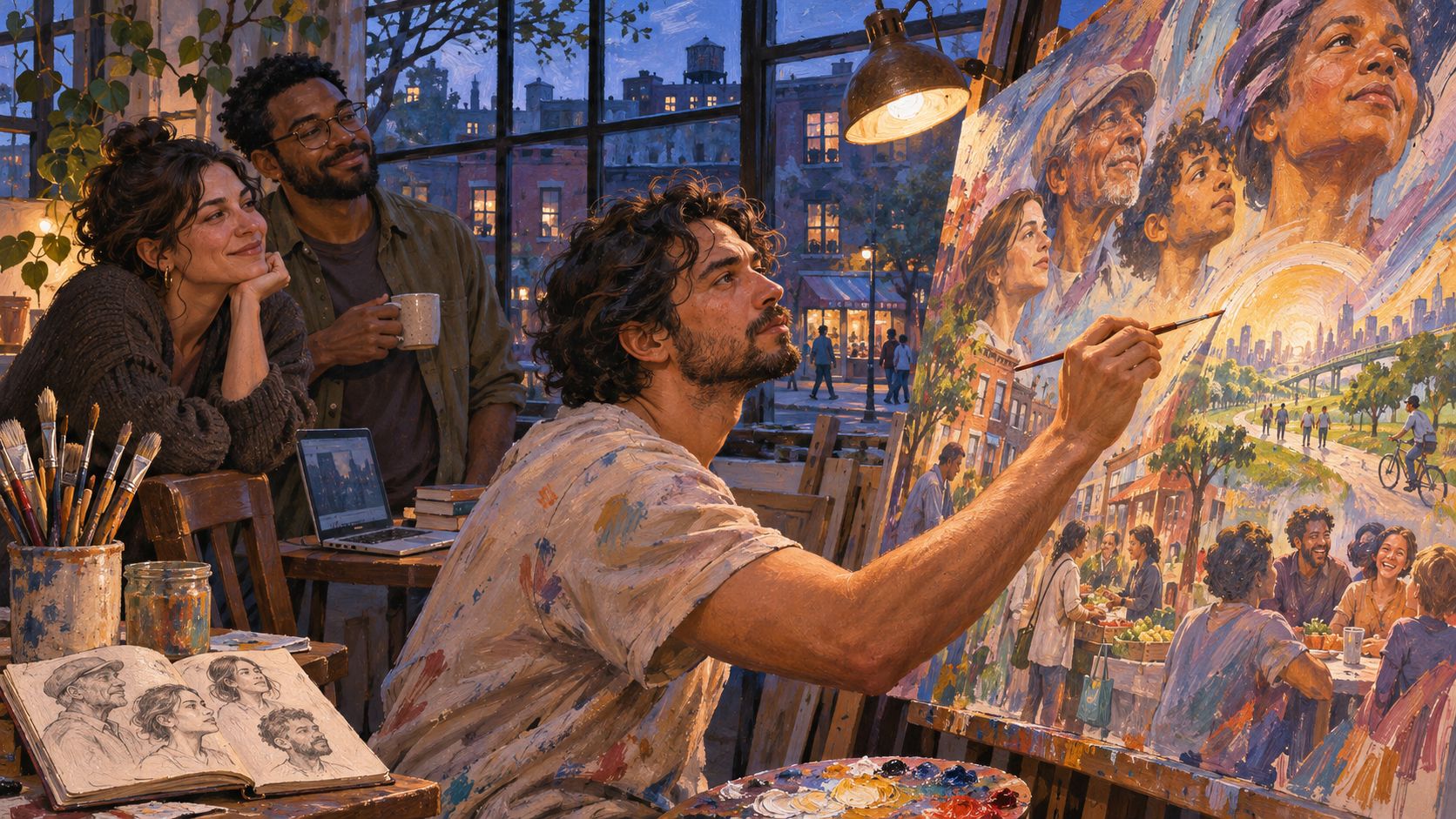
A village can be fed, defended, healed, and well run, and still forget why any of it matters.
Somebody has to remember. Somebody has to make the rest of the village see.
That somebody is the Artist.
Around the First Fires
When the day’s work was done and the village gathered around the fire, someone told the story: The story of the great hunt. The story of the flood and who survived it. The story of where the people came from and what they owed each other. Someone painted the animals on the cave wall. Someone carved the figure, sang the song, danced the dance, and gave the dead their names so they wouldn’t be forgotten.
That was the Artist’s work: memory and meaning. The Artist held the village’s past, made sense of its present, and imagined its future. The Artist took what everyone had lived through and shaped it into something everyone could understand.
The Artist tells the village who it is. A village without Artists can survive. It will just forget why it ever bothered in the first place.
Where You’ll Find Them Today
You’ll find Artists in studios, theaters, recording booths, and writers’ rooms. You’ll also find them in the design department, the ad agency, the kitchen of the restaurant that plates food like a painting, the classroom where history comes alive, and the friend who can tell the story of your disastrous vacation so well you’re glad it happened.
The Artist’s fuel is the moment you finally see it; the instant the shape comes clear or the line that finally lands. The image that suddenly means something. The Artist lives for that click, when something formless becomes something true, both for themselves and for whoever is watching.
Artists come in two kinds:
The Reflector
The Reflector shows the village itself, as it truly is.
Around the first fires, the Reflector was the storyteller who told what really happened, the mimic whose impression of the chief made everyone laugh because it was right, and the painter who put the hunt on the wall exactly as it looked. The Reflector held up a mirror and the village saw itself in it.
Today, the Reflector is the novelist, the documentarian, the journalist with an eye for the human story, the portrait photographer, the satirist, the stand-up comedian, and the memoirist. They’re fed by capturing something so accurately that people recognize themselves. Sometimes it’s flattering. Often it isn’t.
The Reflector keeps the village honest. Without them, a village tells itself comfortable lies and believes them.
The Visionary
The Visionary shows the village what could be.
Around the first fires, the Visionary was the one who told the story of a better place over the mountains, who carved the figure of something no one had seen, and who dreamed the dream the village would spend generations trying to reach.
Today, the Visionary is the designer, the architect, the concept artist, the science-fiction writer, the composer of something no one has heard before, and the person who can describe a future so clearly that others start building it. They’re fed by making the invisible visible, drawing the thing that doesn’t exist yet so everyone else can see it.
The Visionary gives the village somewhere to aim. The Reflector shows the village where it stands. The Visionary shows it where it could go.
When the Artist Is Fed
A fed Artist is luminous. They’re curious, open, playful, and generous with what they see. They notice things other people walk right past and they make those things matter. Being around a fed Artist makes the world look a little more interesting than it did before.
When the Artist Starves
The modern world is flooded with art and starved of Artists. There’s more music, film, and writing than any human could consume in a thousand lifetimes, and most of the people who are built to make it spend their days making spreadsheets. Meanwhile, the work of making is often treated as a hobby, a luxury, or something you do after the real work is done.
An Artist with nothing to make doesn’t stop needing to see. It misfires.
The starving Reflector turns the mirror into a weapon. The eye that could have captured the truth starts cataloguing everyone’s flaws. They become cynical and cutting, the critic of everything and creator of nothing. They mock what they could have portrayed.
The starving Visionary lives in the dream instead of building it. They daydream for hours, plan the novel for years without writing a page, and build rich imaginary lives while the real one goes untended. Or they turn their gift for meaning onto their own life and start manufacturing drama, because a life with a crisis in it at least feels like a story.
And many starving Artists of both kinds consume endlessly, streaming, scrolling, and binging, trying to feel secondhand the click they’re not getting from their own work.
We call these things cynicism, laziness, escapism, and being dramatic. Sometimes they are. Very often, they’re representative of an Artist with no canvas, and the need to see has nowhere to go.
Starve an Artist long enough and even the daydreams dry up. We’ll talk about that another time.
Feeding the Artist When Life Won’t
Make something small, regularly. Not a masterpiece. A sketch, a paragraph, a photograph, a song idea hummed into your phone. The Artist is fed by the making, not by the finished masterpiece.
Show someone. The click is only half the fuel. The other half is watching someone else see it too. Share the work with one person who will actually look.
Reflectors, point the mirror somewhere useful. Write the honest story. Capture the real person. Turn the critic’s eye into the portraitist’s eye. The same gift that cuts can illuminate.
Visionaries, build one piece of the dream. Pick the smallest real part of the thing you’ve been imagining and make it exist. A dream with one brick laid is worth more than a dream with a thousand drawings.
Protect your making time like it’s real work. Because it is. The village has always needed its Artists, even when it forgot to say so.
*****
Every group of people that ever lived is remembered through its Artists. The songs, the stories, the paintings on the wall. Long after the harvests are eaten and the battles forgotten, the Artist’s work is what’s left to say, We were here, and this is what it meant.
So here’s the question for this week:
When was the last time you made something and felt the click, and what were you making?
Next time: the Smith.